
How Do Porta Potties Work?
Under the seat sits a holding tank, usually 60 to 70 gallons on a standard unit. When someone uses it, waste drops straight into that tank instead of a sewer line. There's a chemical charge in the bottom, a blue liquid, that breaks down solids and knocks out the smell you'd otherwise get from an unventilated box in the Florida heat. That's the whole system: no pipes, no pump, no water tank feeding it. A vent stack built into the unit lets gas escape upward and away from the door instead of building up inside. If you want a how do porta potties work diagram to see the tank, vent stack and seat laid out in one image, ask us for one when you request a quote. Our trucks in Pensacola follow ANSI/PSAI Z4.3, which sets a baseline of one service visit per week for up to 10 users across a 40 hour week. Busier sites, like a construction crew or a weekend festival, need more frequent stops. If you're staging units for a crew, our construction site services page walks through counts by headcount, and OSHA 1926.51(c) sets the ratio: one toilet for 20 workers or fewer, scaling up from there. A standard unit runs about 44 by 48 inches on the ground and stands roughly 92 inches tall, so it fits tight lots without eating your whole staging area.
How Do Flushable Porta Potties Work?
A flushable unit uses a small onboard freshwater tank and a foot pump or hand pump to send a rinse of water into the bowl after each use, instead of relying on the holding tank alone. Waste still drops into a sealed tank below, same as a standard unit, but the rinse cuts down splash-back and keeps the bowl visibly clean between service stops. These are what we call deluxe flushable porta potties, and they're the step up from standard when a client wants something closer to a real bathroom feel for a wedding or a long-term jobsite trailer alternative. They still need the same pump-out schedule as any other unit. No unit is plumbed into city water or sewer, so even the flush is self-contained. If you want the full walk-through on tank sizes and features across the line, the portable toilet rental page breaks down every option we run in Pensacola.
How Does a Portable Sink Work?
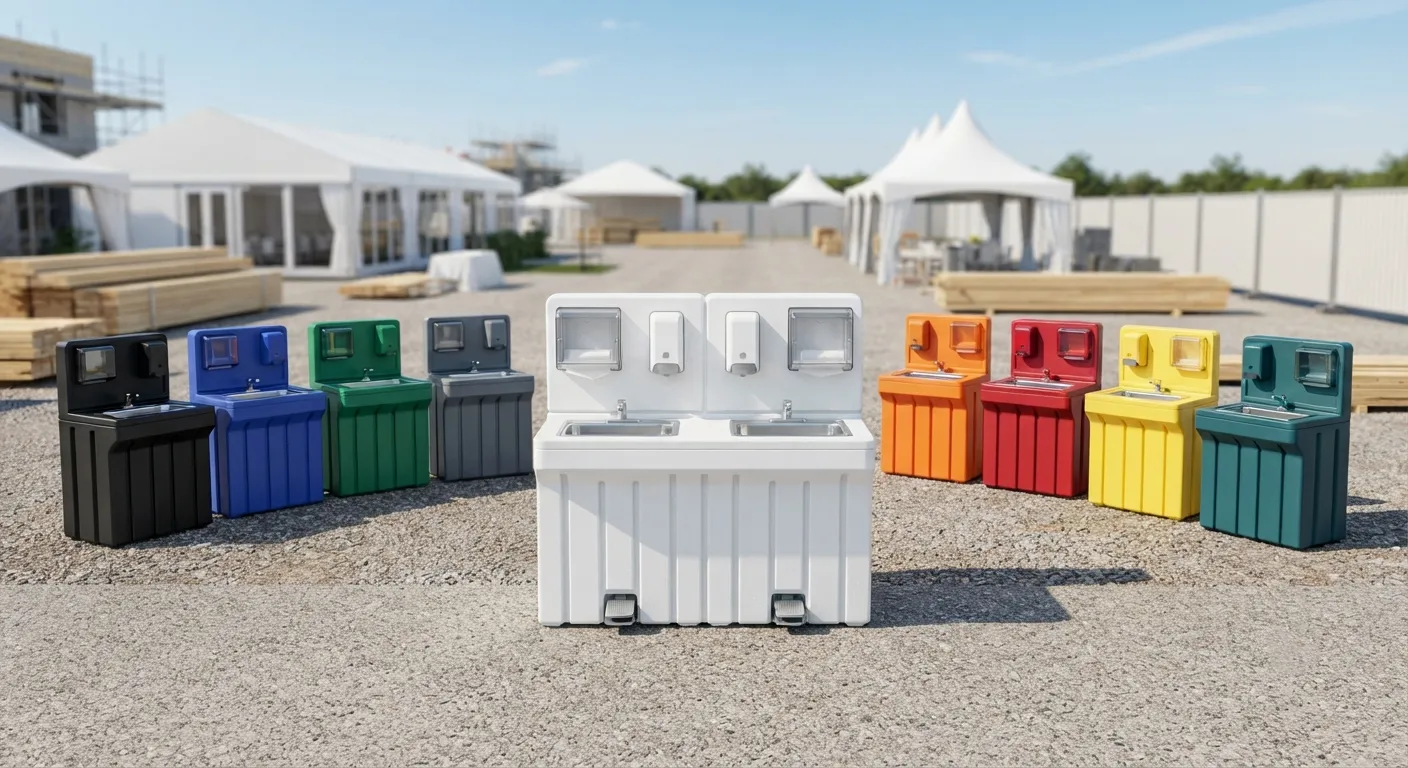
A portable sink runs on the same idea as a porta potty: everything it needs travels with the unit. Fresh water sits in an onboard tank, a foot pump or hand pump pushes it through the faucet, and gray water drains into a separate holding tank underneath instead of a pipe. Soap dispenses from a built-in pump, and under 29 CFR 1910.141(d)(2), a proper washing station has to supply soap and a towel or air dryer, not hand sanitizer alone. That distinction matters on food-service jobs and anywhere OSHA inspects. If your crew is applying paint, coatings, herbicides, or insecticides, OSHA 1926.51(f)(1) specifically requires washing facilities for that contaminant exposure, separate from the general sanitation rule. We pair handwashing station rental units with porta potties on most Pensacola jobsites, and the portable sink rental page has the tank sizes and unit counts if you're speccing a full crew.
Do Porta Potties Need to Be Pumped Like a Septic Tank?
Yes, but on a much shorter cycle. A porta potty's holding tank fills fast with regular use, so it gets pumped weekly under standard service, or more often on a busy site, while a home septic tank runs a completely different clock. A typical residential septic tank only needs pumping every 3 to 5 years, depending on tank size and household size. Both jobs use a vacuum truck, and both rely on the same idea: pull the waste out, don't let solids build past a safe level. For grease traps specifically, a pump-out is triggered when fats, oils, grease and solids hit 25 percent of the liquid depth, which is a different trigger than either a porta potty or a home tank. If your Pensacola property is overdue, septic tank warning signs covers what to watch for, and how often to pump a septic tank goes deeper on that 3 to 5 year window. We run both services out of the same yard, so a crew running septic pumping service work in Goulding, 2.8 miles west of Pensacola, might be the same truck cleaning porta potties on a job in Brent, 5.1 miles northwest.

Frequently Asked Questions
What chemicals go in a porta potty tank?
A blue deodorizing liquid, non-toxic and biodegradable, gets dosed into the tank on delivery and topped off at each service stop. It breaks down waste and masks odor between pump-outs. It's not the same chemical used in septic tank treatments, which target a different bacterial balance in a buried tank. Some homeowners ask about septic tank cleaning chemicals for the same reason they ask about porta potty chemical: both promise to speed up breakdown, but a septic tank cleaning chemical works on a buried tank meant to sit for years, not a portable unit pumped weekly.
Do camping porta potties work the same way as construction units?
Basically yes, just smaller. How do camping porta potties work? Same sealed-tank, chemical-treatment setup as a jobsite unit, just scaled down for portability and easier to move between sites. If you're stocking a remote site, camping porta potty covers the compact options we deliver around Pensacola.
Where do I find portable toilet chemicals near me?
We stock the blue deodorizing chemical for every unit we deliver, so you don't need to source it separately. If you're maintaining your own fleet and searching for portable toilet chemicals near me, we can sell the same non-toxic charge we use on our trucks.
How often does a construction worker need a porta potty nearby?
OSHA doesn't set a distance, but 1926.51(c) sets the ratio: one toilet per 20 workers. Placement matters more locally. Check how many porta potties do I need for crew-size math.
Can a porta potty run out of chemical mid-rental?
Yes, on high-use sites between scheduled service. That's why event rentals get serviced more than once a week. If a unit smells strong before its next stop, call for an early service instead of waiting.
Is there a difference between a porta potty and a portable restroom trailer?
A porta potty is a single sealed unit; a restroom trailer rental has multiple stalls, running water, and often climate control. Trailers cost more but suit weddings and longer events better than stacked single units.
Next step
Get a delivery date
Tell us the address, the dates and the headcount. We size the order and confirm the route.